Showing posts with label Apocalypse Now. Show all posts

Thursday, June 25, 2026

Ad Astra - Apocalypse Now in Space


When Ad Astra came out years ago, I was dismissive. I remember liking the moon sequence, but being underwhelmed aside from that. I don’t know what the fuck was wrong with me. Randomly rewatching it a few weeks ago, I was blown away by it. The fact that it was basically James Gray’s version of Apocalypse Now in space finally clicked with me (Apocalypse Now is one of my favorite films of all time). That alone made me want to write about this movie, even though the film wasn’t exactly relevant. Until recently. First, Robert Duvall passed away, which adds to Apocalypse Now comparison. And when Gray was at Cannes this year, he brought up that he would love to make a director’s cut of Ad Astra, which would be twelve minutes shorter and a very different movie. So after watching the film five times (one of which with the director’s commentary), I felt it was time to write about my latest cinematic obsession.

Apocalypse Now…in Space!


Ad Astra owes a lot to Apocalypse Now, which James Gray admits to in his commentary (more on that commentary later), though he speaks just as much about the source novel for that film, Heart of Darkness. The comparison is easy enough if you’ve seen both films. A soldier is sent on a secret mission to take out a commanding officer who went too far, literally and figuratively, and has lost control. In Apocalypse, the setting is Vietnam, with Col. Kurtz deep in the jungle, acting like a mad king. The soldier, Captain Willard, is on a purely military mission, though his own journey to Kurtz makes him question everything. 


Ad Astra is a much more personal story with astronaut Roy McBride on a mission to stop his father, Cliff McBride, whose brutal attempts to keep his own mission alive have caused dangerous power surges that are wreaking havoc on the entire universe. Unlike in Apocalypse, Roy is ordered to stand down early on due to the personal nature of it all. But Roy defies orders and makes his way to his father. 


This is the biggest difference. Both films delve into what the mission is doing to the protagonist, but Apocalypse Now is much more existential and more concerned with pointing out the absurdity and insanity of war, especially the Vietnam War. Ad Astra isn’t too interested in making statements about space travel in general aside from some commentary about attempting to make the moon just like Earth, which is missing the point of space exploration. Instead, it’s much more about the inner turmoil of Roy. His missing father has dominated his life, resulting in a failed relationship and a constant numbness that makes him oddly suitable for life in space. 


Willard is a man so conditioned by war that it’s become the only thing he can relate to, and Roy has become conditioned by space travel in much the same way.


By the end of Apocalypse Now, Willard seems like a shell of a man. The war and mission has gutted him, but at least he survives. It’s fairly nihilistic. Ad Astra, on the other hand, shows that Roy has had a breakthrough in the end. He is able to rebuild his relationship now that he’s confronted his father. The numbness is gone, and he can finally live a life that is truly his own. It’s a surprising and refreshingly uplifting ending. 


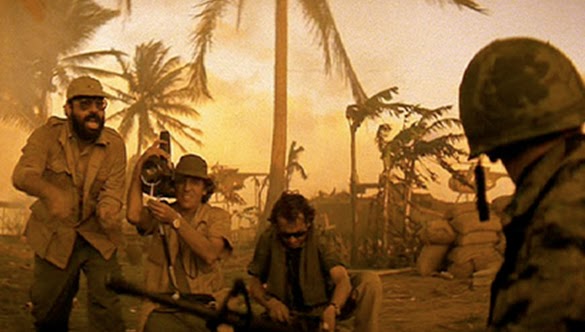
Beyond that admittedly important difference, there are a lot of one to one comparisons between the two films. There’s the basic man on a mission to stop a lone madman, but the debriefing scene is similar, as well, with multiple people being very vague with Roy as they talk about the mission. I think of John Ortiz as the Jerry Zeismer of Ad Astra. (I’ll include a picture below to explain that idiotically specific comparison.) Ortiz talks more than Jerry, but he still exudes the same oddly congenial tone while discussing secretive shit and a mission that ultimately ends with Roy’s father being killed.


Roy’s trip to the moon covers two segments of Apocalypse: the USO show and the attack on the village. When Roy first gets to the moon, we see the Americanification of it with plenty of vendors (there’s even an Applebee’s!) and kids taking pictures with people in alien costumes all while the moon is essentially a warzone. It’s this insane element of “normal” life in an abnormal world. The “Ride of the Valkyries” moment isn’t so much an exact comparison aside from both being the heaviest action set pieces of both films. Though both moments solely exist because the main character is hitching a ride with them. And both moments are arguably the most memorable sequences in both films.


The sequence with the animal research ship is the dead giveaway that this is a version of Apocalypse. It covers multiple comparison points. The crazed primate is the tiger from Apocalypse. Both moments accentuate the truth of “Never get off the boat.” The other moment it mimics is the stopping of the fishing boat. In both moments, the protagonist argues with the captain of the ship to not stop, but gives in. The dark moment when Willard kills the wounded fishermen is also covered with Roy trying to patch up the clearly dead captain with duct tape (“We’d cut ‘em in half with a machine gun and give ‘em a band-aid.”). Although Roy is much more compassionate in this regard than Willard.


The Mars segment is similar to the bridge in Apocalypse Now in that both sequences feel the most, well, apocalyptic. There’s the strange coloring of Mars and the bunker aesthetics of it all, and the continuing surges have everyone feeling a bit crazed.


And finally there’s the Kurtz / Tommy Lee Jones parallels. Both have gone too far, literally and figuratively. Jones is alone, having killed every crew member who eventually wanted to abandon their hopeless mission of finding intelligent human life. He was the only one willing to give up his life on Earth in this pursuit. Kurtz also gave up on everything to create his small kingdom, and he killed anyone who challenged him (“You’re lookin’ at the heads.”). Both men also accepted, and even asked for their deaths. By encountering the soldier tasked with killing them, Kurtz and Jones both have a realization that the only thing that will stop them is death. Once again, Jones’s death is a kind of wake up call for Roy, freeing him from this life. Kurtz’s death frees Willard literally, but there isn’t much hope with his end.


Aside from the specific plot points, there are plenty of other similar aspects. The narration is the big one, though I find the Ad Astra narration largely unnecessary. A lot of it is just stating stuff the film has already conveyed. Not to mention, the Donald Sutherland character allows for Roy to get a lot of his thoughts out there, negating the need for voice-over, at least for that segment. The narration in Apocalypse is vital and often entertaining, by comparison. 


Both protagonists are death-bringers. Lance technically survives in Apocalypse, but that dude is never going to be the same. And Roy gets everyone killed everywhere he goes. The Cepheus crew seem to be nearly suicidal when they attack him. It’s just another aspect to amp up how lonely these characters are.


Most importantly, both movies are beautiful, thought-provoking, and entertaining. It took me a while, but I finally realized how great Ad Astra is, and I now consider it a worthy companion to Apocalypse Now.


The Lack of Duvall


One glaring omission from this comparison is Robert Duvall’s Kilgore. There isn’t a similar character in Ad Astra, and that’s for the best. Duvall shows up and takes over that film for twenty minutes. He’s an example of a type of soldier in that war. A force of nature that the war can’t touch. He’s annoying, hilarious, and somehow still likeable despite his invincible status and love of war. 


There’s simply no way to recapture such a character and performance in any film. And with Ad Astra, such a character would derail the film rather than add to it. Willard is the main character of Apocalypse, but that movie is just as interested in the absurdity of war as it is with his inner turmoil. Ad Astra is all about Roy’s journey, and any side quest with a crazy space man would feel out of place.


And Duvall has no equal, so why bother?


Director’s Cut?


James Gray has spoken about this multiple times, but I’m starting to cool on this prospect. At first, I liked the idea of him doing a director’s cut because it could mean that the narration would be cut back or excised entirely, which I might like. But after listening to his commentary and seeing some behind-the-scenes stuff, I’m not sure what the changes would be.


I still want him to make his cut of the film, especially since its creation doesn’t negate the theatrical cut that I already love. I’m not sure what happened with the film being “taken away” from Gray, but he was involved with the blu-ray special features, so I’m not sure how true that is. I guess his commentary and everything is just him playing ball? So I’m not sure how much stock I can put into anything he said on that. I am interested in his claim that he would make a shorter movie, especially since Ad Astra isn’t that long, especially by space epic standards. Anyway, I checked out all the blu-ray shit, so I’m still going to write a little bit about it.


In the commentary, Gray claims the narration is “essential,” and that he was part of the decision to add it. He also claims plenty of people worked on it, including Charlie Kaufman. The treatment of the narration, and whether it would survive at all, is the most interesting part of the prospect of a director’s cut for me. He also talks about how any movie is like a wild horse that eventually gets away from you, so maybe that’s his diplomatic way of saying the studio took the film away from him in editing.


The deleted scenes don’t offer much. One features a brief flash forward with Pitt and Liv Tyler with a young child. That’s not ground-breaking, since the ending implies they get back together already. 


In one of the behind-the-scenes featurettes, it looks like Gray filmed a rave scene on Mars with people half-naked and whatnot. Maybe Gray shouldn’t get a shot at that director’s cut.


Seriously, though, the possibility of a director’s cut is the final comparison to Apocalypse Now, which has three total cuts. I usually prefer director’s cuts, but I’ve always been a much bigger fan of the theatrical cut of Apocalypse Now, and I think that would end up being the case with Ad Astra, as well. Especially if Gray wants to include a half hour scene with Pitt hanging out at a French space station having dinner and discussing politics. 

Wednesday, March 31, 2021

Apocalypse Now: Final Cut - "Just When I Thought I Was Out, Coppola Pulled Me Back In!"

Before feeling the need to write about Zack Snyder’s Justice League and that director’s need for various cuts of his films, I was going to write about the “Final Cut” of one of favorite films of all time: Apocalypse Now. It turns out writing about Snyder made for a great transition to Francis Ford Coppola, who recently got to re-edit one of his past films, The Godfather: Part III. That new edit made people revisit a famously reviled film and many came away with a more positive reaction (myself included), which is fairly similar to what is currently going on with Snyder’s version of Justice League. Since I’ve already written about Coppola’s new edit of Part III, I figured I’d write about his latest edit of Apocalypse Now, which came out a year and a half ago. The difference with Apocalypse Now is that the film has been considered great since its original release, yet Coppola has revisited the film twice. I want to get into why Coppola can’t leave the film alone (and if that’s a bad thing), why I love the film in general, and which version is my favorite.


The Final Cut - “Why the Fuck Would He Do That?”


Apocalypse Now is arguably more famous for the drama behind the scenes than what ended up onscreen. I’m not about to attempt to get into everything that happened (especially when there are numerous special features you can dive into, including the excellent documentary, Hearts of Darkness: A Filmmaker’s Apocalypse [which is included with most versions of the film]), suffice it to say that Coppola ended up as figuratively and literally upriver as Colonel Kurtz. So if the filming of Apocalypse Now was such a trial for the filmmaker, then why keep coming back to it?


I would like to make the case that making the film was truly like a war for Coppola, and he simply can’t shake the experience. That might be true, but I don’t like how that trivializes actual war. More likely, Coppola has felt the need to re-edit this film because he famously feuds with studios and felt like he had more freedom as time passed to do what he truly wanted to do. With Apocalypse Now, he originally released the Redux version, which basically just included a ton of stuff that ended up being cut from the theatrical release. Apparently, Coppola didn’t consider this a director’s cut so much as a kitchen sink version of the film.


When the time came for a 40th anniversary screening of the film, Coppola was asked which version he wanted them to screen. This is when it occurred to him that neither the Redux or the theatrical cut were his preferred version of the film. And now we have the “Final Cut.” 


I believe Coppola when he claims the Redux wasn’t a director’s cut, but I do think the theatrical cut was the movie he wanted to release at the time. My theory is that Coppola’s taste has changed over the years, and this means his preferred cut for his movies has changed. It’s no different than a viewer revisiting a movie from the past and having a different reaction to it; the difference is that the viewer doesn’t have the power to change the movie. 


Coppola certainly butted heads with studios over the years, but he actually had a lot of freedom when it came to Apocalypse Now. Why else would he be allowed to extend production so far beyond the original plan? Not to mention, he put up a lot of his own money to get the film made. Because of this, I think the theatrical was what he wanted to release at the time. And forty years later, he wanted to change things up. But should he even do this?


Director’s cuts tend to be the better versions of most movies. They are often an attempt by the studio to correct their mistake in hampering the original vision of the director. This is why you get the celebrated versions of Blade Runner, Kingdom of Heaven, Zack Snyder’s Justice League, etc. Typically, a director knows what the best version of the film is. But what if a director does this to a movie people already like and that is already successful? Most famously, George Lucas has revisited the original trilogy of Star Wars to the point that fans have been campaigning for years for the theatrical cuts of those films to get a proper release. They feel his tinkering has fundamentally changed the films they fell in love with. 


I had a similar reaction to Redux. I found the included scenes to ruin the pace and/tone of the theatrical cut. The difference here, though, is that every time a new cut of Apocalypse Now is released on the latest technology, it also includes the theatrical cut. That’s where Lucas, and now Disney, messes up. Change the films all you want, but give fans access to what they loved originally. I don’t care if Coppola and Lucas change their movies once a year, as long as I have access to the version I prefer.


Part of me thinks that directors should generally leave their movies alone, unless the movie was taken away from them, and a director’s cut is the only way to achieve their vision. I like the idea that once a piece of art is out there, it belongs to the world. But the movie fan in me wants to see new versions of films, as long as each version of the film is preserved. I’m down for Coppola’s next “final cut” of Apocalypse Now, if he wants to change it again. I have my copy of the theatrical cut no matter what, so I’m good.


The Voice-over...the Voice-over...


It would probably make more sense for me to move on to which version of Apocalypse Now is my favorite, but I feel the need to explain what I loved about the original cut before I can explain what I don’t like about the two newer cuts.


I love Apocalypse Now for all the reasons you would expect. I find that it captures the absurdity of war while also remaining entertaining. All the famous lines are great, and I just dig movies where characters have to go on a metaphorical and literal journey into the unknown/jungle (this is probably why I’m also a huge fan of Fitzcarraldo and Aguirre, the Wrath of God). But what makes Apocalypse Now stand out to me is Martin Sheen’s voice-over. 


In a film with surfing in a war zone and some of the most iconic lines in film history, my favorite moments are of Willard going through Kurtz’s file. When I watched this when I was much younger, it was the first time I encountered a movie with a voice-over that included cussing. “Why the fuck would he do that?” is still one of my favorite lines from the film. It made me realize that good voice-over can add a realism and darkness to a film that couldn’t be accomplished otherwise. How else could Coppola convey Willard’s surprise at Kurtz’s actions in that scene in an effective way.


I get defensive about the voice-over in Apocalypse Now because narration in films in general is frowned upon. Its use breaks the classic rule: show, don’t tell (which is why I titled this section as a play on “The horror…” line). I get that, but the narration in this film is telling. Yes, it’s exposition, but it’s setting up Kurtz’s character while also revealing Willard’s through his reactions and attempts to understand Kurtz. A line early in the film explains why the voice-over is necessary: “There is no way to tell his story without telling my own. And if his story really is a confession, then so is mine.” The voice-over is Willard’s confession, and we’re the absolving priest for listening to it.


Obviously Coppola felt strongly about the narration, as well, since he gives a credit just for the narration to Michael Herr (who also received the same credit for Coppola’s The Rainmaker), who’s an authority on Vietnam since he was a war correspondent who went on to write Dispatches and the screenplay for Full Metal Jacket. Coppola realized how important the voice-over would be, both for the story and for the authenticity of the film.


In that regard, I find it perfect. The voice-over provides plenty of character development while also placing you in the mind of a soldier. For me, it draws me into the film completely. Once Willard’s narration begins, I’m in for the whole film. Or the whole theatrical cut, I should say.


Favorite Cut - “You’re Looking at the [Redux]. Sometimes He Goes Too Far.”


In general, when I love a movie and a version with more footage comes out, I get interested. If I loved two plus hours of this, then surely I’ll love another hour of it. But that just isn’t the case for me with this film. 


Coppola kind of admits this by even creating the “Final Cut.” This cut is his way of saying Redux was just too much. But it’s not just that it’s too much, it’s that the majority of the added material seems to be from a different movie. I want to break down three major additions to Redux: stealing Kilgore’s surfboard, meeting up with the Playboy bunnies, and the...ugh...French plantation sequence.


Due to the voice-over, Willard comes across as a very serious killer. He’s not completely joyless or emotionless, but he’s there for a job (which would explain his killing of the injured woman on the boat and the crew of the PT boat not exactly loving him). This is a bit different from John Milius’s script, which presented itself more as a version of The Odyssey AND Heart of Darkness. Updating The Odyssey into a more modern setting, no matter how dark, still leads to goofiness (just look at how it works in the Depression in O Brother, Where Art Thou?), and that clashed with the Heart of Darkness storyline. So when Milius’s Odyssey stuff is left in, it makes the film feel like two separate stories with two different main characters. 


With The Odyssey adaptation in mind, that makes Kilgore the Cyclops, who is defeated by the wittiness of Odysseus. In this case, it means Willard has to steal Kilgore’s surfboard to defeat him. That kind of bold movie might work for Odysseus, but for Willard it’s uncharacteristic. What had he done so far to suggest he would do such a thing?


Yes, he clearly had a disdain for Kilgore, who he sees as fighting a different kind of war. Stealing the surfboard in itself isn’t necessarily against his character; his reaction is, however. Willard jumps onto the boat with the board, laughing. Later, he jokes around with the guys on the boat as a chopper flies by playing a recorded message from Kilgore pleading for his lost eye...I mean, surfboard. It creates a bonding moment with the guys on the boat that disappears in other scenes.


After besting the Cyclops, Willard and his crew must deal with the Playboy bunnies, sirens who keep them from their mission. Once again, this is simply not in keeping with other scenes. It feels shoe-horned in to fit this Odyssey theme.


Finally, and worstly, we get the French plantation scene. In an already long movie, the film grinds to a complete halt as we deal with the Lotus Eaters of Milius’s script. The French serve as an unnecessary history lesson for the film and as a warning to Willard, and America, to respect the Vietnamese resolve. Once again, this takes away from the stronger Heart of Darkness aspect of the film. As a loose adaptation of Heart of Darkness, Apocalypse Now is a film about war in general and the madness and abuse of power that comes with it. Including the French makes this movie just about the Vietnam War, which turns it into more of a historical document than a statement about war itself. 


Most importantly, the French plantation sequence is just way too long, and it makes the film lose focus. I get that that is part of the point, but when there’s already a great theatrical cut of this film, why fuck it up with a French dinner scene? 


When the “Final Cut” was announced, I assumed this would be the first thing to go. Nope. Instead, Coppola mainly just got rid of the extra Playboy bunny stuff. Because of this, I do prefer this cut to Redux, but neither of them are even close to the theatrical cut.


What I wished Coppola had done instead was make a cut of the film that omitted as much of the Heart of Darkness stuff as possible and inserted all The Odyssey stuff. There might be a way to make two completely different versions of this film with a completely different main character. I would find that infinitely more fascinating than just adding shit in that doesn’t jive with the rest of the movie. I like The Odyssey stuff in itself and thematically, but I hate how it clashes with the film I know and love.


I’m glad to have these two alternate cuts of Apocalypse Now, but I feel that most of the stuff added could’ve just been presented as deleted scenes. Perhaps others really dig all the extra stuff, but for me, whenever I watch Apocalypse Now in the future, it will always be the theatrical cut.


Why Do I Own This?


Apocalypse Now is one of my favorite movies of all time. Until recently, I would tell people that it was my singular favorite film ever (now, if I’m forced to pick just one, I go with The Thing). So I’ve bought this movie multiple times. I had the original cut on DVD, then I got the “Complete Dossier” version, then I got the “Full Disclosure” version, and now I have the “Final Cut.” Let’s hope it truly is final because buying a movie this many times is pretty fucking stupid.


Random Thoughts/Favorite Quotes*


*Just assume I dig all the famous quotes, too. I just don’t feel the need to type out all the lines everybody loves. 


On IMDb trivia, it claims that Martin Sheen’s brother, Joe Estevez, provided the voice-over while Sheen recovered from his heart attack. But this is the only place I have found this info, so I doubt this was the case. But if it is true, well done, Joe Estevez!


I'm a huge Doors fan, so any film that starts with "The End" is a winner in my book.


"If his story is a confession, then so is mine."


G. D. Spradlin is perfect casting for a general that's giving nefarious orders while sounding folksy as fuck.


"...this [...] army of his that worship the man like a god. And follow every order, however ridiculous." Sounds familiar…


I love the absurdity of the general and CIA dude having this discussion with Willard during a meal.


Jerry the CIA dude is perfectly normal looking, which makes him kind of terrifying.


Originally, the soundtrack was going to be nothing but Doors songs. I would totally dig that, but I can't imagine this movie without its score now. It's so perfectly eerie. 


Aside from some diegetic music, the music of the film is fitting for a horror film, which it is.


"Airborne? He was 38 years old. Why the fuck would he do that?"


Kilgore's salute and general disdain towards Willard always amuses me.


Kilgore's interaction with the dying VC soldier perfectly encapsulates his character. Honorable enough to give water to a dying enemy, but enough of a dick to get distracted while doing so and pour the water just out of reach of the soldier's mouth.


I always forget that R. Lee Ermey is in this (Kilgore's helicopter pilot).


"What do you know about surfing? You're from goddamn New Jersey!"


I've watched this movie dozens of times, but I can never tell what the Playboy promoter guy throws on the ground before he takes off on the chopper.


Willard is seen as so brutal for killing the injured woman on the boat, but I don't think it's any worse than the initial shooting.


The pure chaos of the situation at the bridge that keeps being destroyed and rebuilt is terrifying. I'm sure all war is chaotic, but that seems particularly insane.


Ugh...the French plantation section.


So we’re two hours in and we still haven’t seen Kurtz onscreen, so let’s stop to eat dinner and smoke opium with the fuckin’ Frenchies?


The annoying sounds Harry and Lloyd make in Dumb & Dumber don't have shit on the noise Lance makes when they're going through the fog.


Chief kind of gets on my nerves (I think he cuts Clean too much slack and always seems to be harsh on Chef), but I respect his decision to try to choke out Willard as he dies.


"The heads. You're looking at the heads. Sometimes he goes too far."


Kurtz talking about the Ohio River always interests me because I live in a town on the Ohio River. I’ve never come across an abandoned gardenia plantation, but I have been on the river many times and come across stretches where there is nothing on either side and felt an odd peace being in a place with no signs of civilization. I hope I’m not becoming like Kurtz…


“We train young men to drop fire on people, but their commanders won’t allow them to write ‘fuck’ on their airplanes because it’s obscene!”


Tuesday, January 14, 2020

"Universal Soldier: Day of Reckoning" - The weirdest and best film in the series.

*This article contains SPOILERS.

I always wondered what one of the truly great, original directors would do with a Van Damme movie. Sure, he’s worked with some renowned action directors here and there, but what would Kubrick have done with a Van Damme movie? Of course that’s an impossibility, and it’s very unlikely that any director of Kubrick’s ilk (PTA, Scorsese, Aronofsky, etc.) will ever work with Van Damme. But that doesn’t mean a skilled imitation can’t happen; in fact, it already has. Writer-director John Hyams has made the closest thing we’ll likely ever get. His Day of Reckoning feels more like a unique director’s vision than any other Van Damme movie. The comparison that came to mind as I watched was Nicolas Winding Refn. The general look of the film, a mostly quiet protagonist, striking images of sex and ultraviolence, and the general mysteriousness of the film make it very much like Refn’s work. To be clear, I don’t think Hyams was copying Refn. I just thought of Refn as I watched it. Day of Reckoning is simply the product of Hyams being able to do whatever the fuck he wanted, and I am so glad he did.

Universal Soldier: Unleashed

The Universal Soldier series (the Van Damme entries) is truly strange. The first film is pure ‘90s action fun. The sequel attempted to recapture that feeling, but failed (at least commercially; I actually like it in a guilty pleasure kind of way). Then director John Hyams entered the picture and made Regeneration one of the most surprisingly awesome DTV movies of all time. That entry was much darker than the first two films, but Hyams was just getting started. Hyams wanted to do something special with the series, but he also did something very simple: take the idea of the UniSol program to its logical, violent, insane conclusion. Let me explain. 

I love the Universal Soldier series, but I always found it a bit lacking when it came to considering the ramifications of the program. For fuck’s sake, they are re-animating dead Vietnam soldiers as cyborg assassins! And it’s a fairly light-hearted series for the first two movies. This is some dark shit, and Day of Reckoning finally dives deep into the darkness. The UniSols of this film have survived too long, and they are all pretty much crazy. The scenes in the bunker are fairly disturbing. The UniSols just sit around, amped up and drunk, just wanting to kill something because they know nothing else. Andrew Scott and Luc Deveraux claim to be their liberators, but really they’re just masters of a different name. And when John takes over at the end, he’s still just using the UniSols to do his bidding. 

Only death can free these men, but they’ve already died, multiple times in many cases. The film ends with the revelation that John has created a clone to infiltrate the government agency that controls the program. Terrible things are going to happen because John, a government creation meant to stop the rogue UniSols, has chosen to believe the revenge narrative they created. It’s a vicious cycle that seemingly has no end, and that’s the point. Where else could this program go? I know this is covered to a degree in all these films, but this felt like the most realistic and fully formed exploration of the consequences of the program.

One of the main consequences of the program is violence. Of course, the entire series is violent, but only Day of Reckoning garnered an NC-17 because of it. This is because the use of guns is toned down...a bit. The gunplay is still there, and it’s gorier than ever. But the most brutal moments of the film don’t feature guns at all. One such moment involves a fight with baseball bats. In a generally great sequence, John realizes his abilities while fighting off a would-be UniSol assassin in a sporting goods store. After an awesome bat on bat fight, John gains the upper hand and eviscerates his attacker’s head with one swing. I don’t know what else to say except that it’s fucking awesome, and it’s the kind of thing I always wanted from this series. Because what’s the point of creating supersoldiers just to have them pull a trigger. Give those fuckers bats and machetes and let them go crazy.

And Day of Reckoning is truly crazy on many levels. The fact that many of the characters are either under mind control, can’t remember their past, or are flat out rage monsters creates an unnerving mood throughout. But the sound and visuals amp it up even further. The sequences in which Van Damme seems to be telepathically recruiting characters are particularly difficult to watch. The primary example of this is when the UniSol is recruited by Lundgren after the brothel massacre. The flashing lights and the chaotic score along with images of a bald Van Damme make it an extremely effective scene. It’s hardly something you would expect from this franchise.

And that’s precisely why it’s the best film in the series. Day of Reckoning is possibly the boldest sequel ever made. It’s a violent head trip, and it’s everything a Universal Soldier movie could and should be.


Universal Soldier: Apocalypse Now

While I found a lot of similarities to Refn’s work in Day of Reckoning, the most blatant homage is to Coppola’s Apocalypse Now. Actually, Day of Reckoning is damn near a remake. The basic plot is a soldier (Scott Adkins) is sent by the government (in this case, though, he’s unaware of the government’s involvement until later) to take out a rogue superior (Van Damme) who has gone insane and started his own army. He eventually makes his way to Van Damme, even going down a river at one point. The ending is where it diverges a bit from Apocalypse Now, even though he still kills Van Damme with a machete much like how Brando dies in Apocalypse. The difference is that rather than simply leaving, he takes Van Damme’s place, albeit with a much smaller army (you know, because he killed almost all of them earlier). The fact that he kills many of them could be a reference to the note Brando leaves for Willard telling him to kill them all. Small differences aside, this is very clearly meant to be a tribute of sorts to Apocalypse Now. And this is a logical film to emulate as Van Damme and Lundgren's characters were originally soldiers in the Vietnam War, and Lundgren's character was kind of an amped-up Kurtz himself in the first film. 

Van Damme’s screen time and overall performance and appearance is further evidence of the connection. Van Damme is barely in this movie. He shows up in the beginning scene, but after that he is only seen in glimpses or very short scenes, which is how Kurtz is portrayed in Apocalypse, as he’s heard in an audio recording early on, then we just see pictures of him. Both Deveraux and Kurtz hang like specters over their films. They are mysterious, dangerous men that our protagonist must face. 

Van Damme’s screen time is almost identical to Brando’s, but so is his appearance. He has a shaved head, and he even paints his face later in the film (seemingly for no other reason than to further resemble Kurtz). Van Damme also matches Brando’s understated performance. He is mostly quiet, which makes for one of the most effective, and definitely eeriest roles of his career. This is not a knock against Van Damme, but I’ve always thought his presence was more powerful when he is more silent. This is why his darker, more villainous roles stand out because when he stands around stone-faced he looks creepy as hell. 

It’s easy to be disappointed by how little Van Damme is in this film, but when you understand the design of the story (and it’s homage to Apocalypse Now), it makes perfect sense. And it makes for a more potent performance from Van Damme. If he had been around every other scene just being brooding and evil, it would have become a bit tiresome by the end. Better to leave him the mystery that must be found rather than to pull the curtain back too soon. Screen time doesn’t matter when his presence can be felt throughout the film. It’s a unique and great performance from Van Damme in easily one of the most interesting films he’s ever been involved in. 

Why Do I Own This?

It’s a Jean-Claude Van Damme movie. In fact, I bought it twice, technically. It was cheaper to by a Regeneration / Day of Reckoning combo DVD than buying Regeneration by itself. But then I found out that the DVD version of Day of Reckoning was not the uncut, NC-17 version. So I had to buy the blu ray. I’m glad I did, though, because the extra brutality in the uncut version is worth it.


Random Thoughts

That murder at the beginning is definitely the darkest thing Van Damme has ever filmed.

The craziest little whorehouse in the fucking world…

This movie needs a seizure warning. Seriously. The flashing lights and whatnot are difficult to watch.

What a terrifying cult: a group of genetically enhanced super soldiers sitting around whiskey drunk all the time just waiting for an excuse to start beating the shit out of each other.

I watched this right after John Wick 3 (I definitely need to watch something with less death now), and the sequence when Adkins kills all the UniSols is just as good as a sequence in the Wick series. Obviously Wick is the more premiere series, especially since there are multiple impressive sequences throughout those films while this film just has the one, but it's still very impressive for any action film, much less a DTV one.

Lundgren gets two badass deaths in back-to-back movies. That's rare because when most characters die in a movie, they stay dead.

UniSols using baseball bats and machetes makes for much better (and exponentially more gruesome) action.