Showing posts with label Dracula. Show all posts

Saturday, January 31, 2026

Dracula - Now with Gargoyles!

Dracula is one of those properties that never loses relevance. Just off the top of my head, I can name four versions from just the past two to three years: Renfield, Nosferatu (Nicholas Hoult is a fan!), The Last Voyage of the Demeter, and Rade Jude’s AI Dracula (which I haven’t seen yet, but I’m definitely interested in). And now Luc Besson has bloodied the waters with his version.

Ignoring the allegations and general creepy shit (dating and eventually marrying a fifteen-year-old) about Besson, I’m still not the biggest fan of his work. The Fifth Element is the only film of his I truly enjoy. That written, when I see his name attached to something, I know it’s going to be at least a little interesting. That’s what makes his version of Dracula so disappointing.


This feels like a shallow remake of Francis Ford Coppola’s Bram Stoker’s Dracula more than a new adaptation of the source material. It starts in the 1400s with Vlad going off to war, then he renounces God when his beloved Elisabeta dies. Four centuries later, he looks crazy old and has a ridiculous wig. He comes across the reincarnated Elisabeta, and he attempts to reunite with her. 


There are a few differences, of course. This time, it’s set in Paris instead of London (though everyone speaks English). Instead of just being supernaturally charismatic, Dracula has to make a magical perfume to charm women. And instead of a harem of brides, he has…CGI gargoyles. The Paris aspect is fine, but the perfume and gargoyles are silly at best, and distractingly stupid at worst. 


This would be forgivable if the rest of the film was interesting. But I didn’t care about any of the characters, even with a cast that includes Christoph Waltz (just sleepwalking through yet another eccentric professional role). The violence is basic, and the film is oddly light on blood and sex, despite the R-rating. I suppose the costumes were interesting, but that’s certainly not enough to save anything. 


Caleb Landy Jones is a unique choice for Dracula. Oddly, though, I only found him interesting when he was in old-man make-up. He seems like a bit of a doofus when he’s young-looking. (He’s way too impressed with a puppet show at one point. You’re over four hundred years old; puppets shouldn’t evoke any reaction from you at all, man.) But as an old man, he’s engaging. Easily my favorite segment of the film is when he’s dropping exposition on Harker. It should be a weak point in the film, but it held my interest the most thanks to Jones’s performance. 


It’s almost as if the script was altered to make up for Jones’s lack of charisma. It would be too unbelievable that he could drive an entire nunnery wild, so they had to add in a magical perfume to explain it. 


Perhaps I’m being too negative on the film, but because it’s Dracula I’m going to be harsher. First off, I’m a huge fan, and I try to watch every adaptation that comes out, even if there’s one or two every year, it seems. Second, and more importantly, since this is a property that has been adapted so many times, any new take needs to justify its existence, and this doesn’t. There is no reason for this to exist aside from Besson just feeling like making Bram Stoker’s Dracula but in Paris with a weaker script and visuals. Oh, and gargoyles. 


The silly gargoyles will most likely be this film’s legacy. I’m not sure there is a good way to do it, but the CGI here is a bit weak. Beyond that, it just doesn’t make sense. So Dracula needs to spend years developing his Spanish fly perfume, but he’s able to make gargoyles come to life? (SPOILER alert: they’re revealed to be children at the end after his death, which is definitely horrifying but no less baffling.) Is it some kind of dumbass commentary on pleasing women or something? It’s easier to bring a gargoyle to life than it is to impress a woman. There are odd elements of humor (like Dracula’s ridiculous laugh when confronting Harker), but I can’t imagine the gargoyles are intended solely for comedy. And since it’s rated R, it’s not like they’re there to keep younger audience members entertained. The gargoyles clearly served only as a distraction to me. 


This film might have worked if Besson had taken Dracula’s life story told to Harker and just made that the movie. I would’ve taken an entire movie about him trying to kill himself, and then deciding to make the world’s most effective perfume over yet another re-tread. But this forgettable adaptation is what we got. Oh well, I’ll just check out the next adaptation that will probably come out in the next year or so.


Monday, July 9, 2018

Herzog/Kinski #2 - "Nosferatu: Phantom der Nacht"

*As always, I wrote this article with SPOILERS throughout. But who doesn’t know all the spoilers for a Dracula movie at this point?

This is a unique entry for me because I’ve owned this movie for years, but I have never watched it. You would think a site called “Why Do I Own This?” would be about movies I have already seen, but that’s not the case. I have rarely purchased a movie without watching it first (I did buy Alien: Covenant without watching it because I’m a huge fan of the franchise and knew I’d at least slightly like it [I did]). But when I buy sets of movies, sometimes a movie or two is included that I haven’t seen. For instance, I haven’t seen a few movies in the Mel Brooks collection I bought a while back (which probably means I’ll be writing about that collection soon). With the Herzog/Kinski set, there were four (of six!) that I had not seen, and two I did not watch until I decided to write these articles. Nosferatu: Phantom der Nacht is the first of these films (Woyzeck is next).

So why would I buy a set of films that I had not watched entirely? First off, this was bought at a time when I felt required to buy a movie a week (I started this site to make myself watch some of my too large collection to justify its existence). Second, and more importantly, I loved Aguirre and Fitzcarraldo so much that I knew I would like everything Herzog and Kinski produced. So far, I am correct. We’ll find out for sure next week. For now, here’s Herzog and Kinski’s version of Nosferatu.


I’ve seen this before...but not done by Werner Herzog.

I don’t have a good excuse for why I skipped this one for so long. I like vampire movies, especially adaptations of Dracula (even if this one is unofficial just like the original Nosferatu). But perhaps that’s also why I skipped it. It’s a story I’ve seen many times, and I can’t imagine liking a version more than Coppola’s. (I am a huge fan of that version and watch it at least once a year; I don’t even consider Keanu Reeves’s casting distracting.) That’s still the case, but I should have known Herzog would do something unique with the story.

The most surprising element is the lack of blood. For a film about a vampire, there is almost no blood (compared to Coppola’s fountains of blood). It’s odd, but I honestly didn’t think about it until near the end of the film. It’s as if Herzog gave himself a challenge, but looking through his career, he is not a gory filmmaker. His films contain violence, but they never revel it it. His focus here was to create a mood, and he certainly did that.

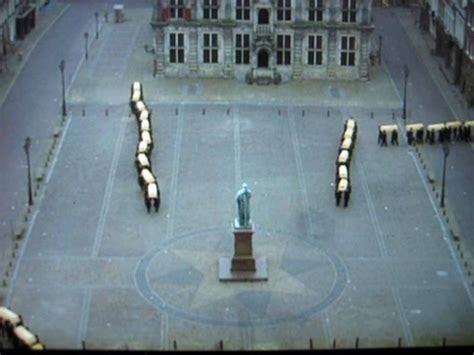
The use of music and some great exterior shots set the otherworldly tone for this film. But what elevated it for me the most was Herzog’s focus on death. Nosferatu brings the plague with him, and the second half of the film becomes a straight up plague movie culminating in a great sequence of hysteria that comes with mass death. The character of Lucy stumbles through a chaotic scene of caskets, bodies, and insanity. It’s much more interesting than watching a vampire sneak into a bedroom over and over again. Herzog is more interested in what the vampire represents, and what that would do to an entire town.

Herzog is also one of the first directors (as far as I know; I’m no Dracula film scholar) to humanize Dracula by making him unhappy with his immortality (an idea that Coppola ran with). Kinski makes for one of the most disturbing versions of the villain, yet you still sense a scrap of humanity left within him.

I’m a bit embarrassed that I’m just now seeing this film. I think if I had seen this before Coppola’s version, then it might be my favorite. But Coppola’s version is burnt in my memory as the version of Dracula. But Nosferatu: Phantom der Nacht is a close second because it is so different while also staying the same.


Kinski, the animal.

Even though Herzog humanizes Nosferatu a bit (and even claims Kinski made the character more human-like in the commentary), it’s hard to watch Kinski and think of a creature in human form. His physical performance is very unsettling, and when you finally see him feed, it’s sickening in it animality. (By the way, I just realized “animality” is a real word; I hope it means what I think it does.) And even though Herzog claims this version is more human, he later states that he asked Kinski to move like a crab, just as he did with Aguirre. Perhaps the key to their creative relationship was that one direction: “Move like a crab!”

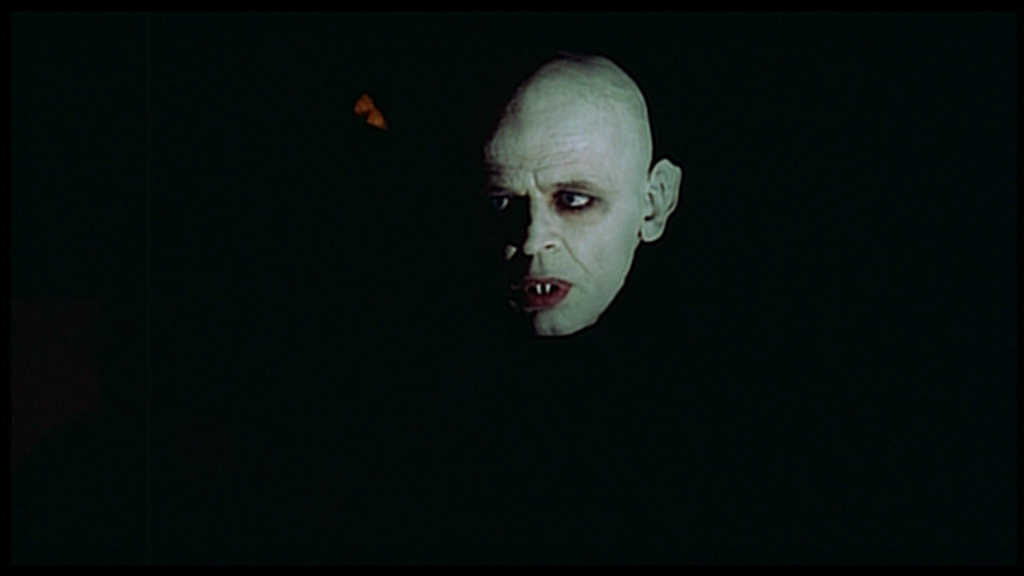
Kinski is already a strange looking man, but add the makeup and prosthetics and he truly becomes a monster. But it’s the way he skulks around, the way he stares, and the way he makes use of his claw-like hands that make the performance. He is worthy successor to Max Schreck, and is arguably more frightening.

As for the typical Kinski shenanigans, there really aren’t any. Apparently, Herzog used the Aguirre technique, in which he let Kinski play it big for many scenes and argued with him between and before scenes to tire Kinski out to get the subdued performance Herzog wanted. And subdued it is. There is a lack of energy to Kinski’s Nosferatu, but it somehow makes him more frightening.

As for Kinski’s offscreen issues, I couldn’t find any aside from comments about him being difficult in general. There is no gun story with this film. Funnily enough, my first thought when I saw Kinski was, “What did that poor makeup artist have to endure each day?” Apparently, I’m not the only person to think this as IMDb’s trivia section’s first entry states that Kinski was surprisingly well-behaved for the make-up sessions and became friends with the artist. But don’t forget, Klaus Kinski is (probably) a piece of shit.


Would I buy this if it wasn’t part of the collection?

No, but my criteria for purchasing has gone up just a bit. Years ago, during my must-buy-at-least-one-movie-each-week-no-matter-what phase, I would have bought this. I used to rewatch movies a lot more back then, though. These days, I had to make a website to make myself watch movies from my collection. So something has to really speak to me for me to buy it. (That written, I still add at least twenty movies to my collection each year.)

I did really enjoy Nosferatu, though. But Coppola’s Dracula will always be my favorite vampire movie, and it will likely be the only one I rewatch with any regularity. Although I do find myself watching Dracula 2000 (I don’t know why, but that movie really worked for me) Dracula: Dead and Loving It (the enema jokes and fountains of blood crack me up), and Interview with the Vampire (I’ve read all the Anne Rice novels and thought the movie was a faithful and entertaining adaptation). So there’s just no room for Nosferatu, but I’ll always have it just in case.

Random Thoughts

Renfield gets on my fucking nerves, which might be the point, but still.

The music, thought repetitive, is very effective.

Okay, maybe Malick did rip Herzog off. Nature shots as a character witnesses a new place set to Wagner’s “Rheingold"? That's pretty much every other scene of The New World.

Kinski’s disembodied head in one of his first scenes is unsettling.

Lines of coffins like slithering snakes. Herzog is still in the jungle.

An apocalyptic Dracula film.

Bruno Ganz is pretty great in this. It’s a shame this is the only film he made with Herzog.