Showing posts with label Christopher Nolan. Show all posts

Thursday, July 16, 2026

The Odyssey - Spoilers and Random Thoughts

My spoiler-free review of The Odyssey conveys the gist of my thoughts on the film, but I had a lot of stray branches I wanted to touch on that warranted its own post. So this will be much more disjointed and filled with SPOILERS.

IMAX 70MM


As a Nolan fan, I go into his films wanting to like them. Actually, I want to like everything I see, but with Nolan I’m willing to rewatch a film a few times if it isn’t clicking with me the way it is with others. This is what happened with Oppenheimer, which took me multiple viewings to fully enjoy. (I plan on revisiting Dunkirk again in the future, because I was very underwhelmed with that one while others consider it his best work.) Anyway, it’s something I’m aware of, and it’s why I usually like to put some time between watching his films and reviewing them. I take the format I watched them in into the equation, as well. In this case, it was 70MM IMAX.


The Odyssey is the first film I’ve seen in 70MM. The closest IMAX to me (in Evansville, IN) is standard. I was able to make the trip to Indianapolis for this film, however, finally seeing a film in 70MM. I was taken aback at first with the height of the screen, but I ended up loving the format. 


The point of all this is that there were factors at play that amplified my enjoyment of this film, and only time, and smaller formats, will tell if this one will keep its place among my favorites of Nolan’s filmography. But right now, I really fucking liked it. 


The Logical Follow-up to Oppenheimer


For most of the film, the only issue that was forming was Odysseus’s guilt and reluctance to go home. It didn't click with me what the problem was. He won the war, so what was the problem? The deception of the Trojan horse and the sack of Troy are so embedded in culture that I never even thought of the emotional impact of such betrayal and misery. So when he revealed all of this to Penelope and Athena (who is in the form of a priestess executed in front of him), it hit me hard. This is a man reckoning with the death and carnage brought on because of his plan, which he sees reaching beyond just Troy as he set the example that the rules of hospitality no longer need to be honored. This is just like the back half of Oppenheimer in which he takes indignity and indignity because he feels like he deserved it. 


Oppenheimer was criticized (most notably by well-known subtle person James Cameron) by some for not showing the effects of the bomb and instead focusing on Oppenheimer’s personal experiences. Since he was not there when the bombs dropped, the film would not show them. The focus is instead on his feeling of guilt which is manifested quite effectively in his victory speech (that isolated scream gives me chills no matter how many times I hear it) and his imagination of stepping through charred bodies. 


With The Odyssey, Nolan gives you the bomb and the guilt. We witness the sacking of Troy as Odysseus watches on in horror. I don’t think this is Nolan responding to Oppenheimer criticism. It’s just that this time he chose a story in which the creator of destruction personally witnessed it, as well. Anyway, there should be no bullshit complaints this time about literally showing what the main character feels guilty about. 


On a side note, I thought the casting of Benny Safdie as Agamemnon was interesting since he played Teller in Oppenheimer, who focused on surpassing the atomic bomb by developing hydrogen weapons. He’s the arbiter of destruction here, as well, wanting war with Troy no matter the reason. His characters also end their screen time in both films with a woman looking at them quite angrily, in both cases deservedly so.


Costumes and Casting “Controversy”


First off, I think the vast majority of people being bitches online about the casting and the costumes of this film are either bots, people who never planned on watching the movie ever anyway, and/or racists/transphobes. This is why I didn’t want to even acknowledge it in my actual review because it’s so fucking stupid. But I’m a creature of the internet, so I’ll get into it a little bit.


The Lupita Nyong’o shit is just racist, plain and simple. This is a modern film about a fictional epic, the cast is who it is. Beauty is famously in the eye of the beholder, so if she’s not beautiful enough for you, then fine, but don’t be a bitch about it. She’s great in the small amount of screen time she has, by the way. Nolan needed an actress in a dual role that could convey supreme sadness in one scene and righteous fury in another, and he chose well.


Also, if you’re pissed off about Nyong’o, but you’re okay with Matt Damon or any of the other non-Greeks playing Greeks, then that says it all. It’s a fucking movie about a mythological story, so it’s not going to be “historically accurate,” whatever the fuck that means anyway. I fucking hate the internet sometimes.


The other target of online bullshit is the casting of Elliot Page. At first, people thought he was cast as Achilles, but it turns out to be Sinon, the soldier left behind to convince the Trojans the horse was a gift. I’ve seen some people post things in defense of the casting along the lines of “Calm down, he’s not playing Achilles.” I get that since Achilles was supposed to be a huge warrior (my Humanities professor complained about Brad Pitt being too small for the role back when Troy was coming out). But even if he was Achilles, who gives a fuck? It’s not like Achilles would have a big role in this film if he was featured in it, so I don’t get the outrage. It’s all just transphobic bullshit, and it’s exhausting. For the record, I thought Page was great in the role, especially in the speaking dead sequence. 


Travis Scott is another inclusion that has bothered some, but not so much for his role. The end credits feature a Scott song. Once again, so what? I saw one clickbait post saying it would be like “if Schindler’s List ended with an Imagine Dragons song.” First off, the comparison makes no fucking sense; at least pick an artist from that time period if you’re going to make that joke. Second, the film doesn’t “end” with the song; it plays over the credits. You know, the same way Tenet had a Travis Scott song play over the credits? I’m not even a fan of Travis Scott’s music, but I don’t care if his music plays over the credits. 


There were also plenty of complaints about the costumes. Most recently a picture of Jon Bernthal was released in which he was wearing a simple leather doublet. Dipshits online were complaining that this would be more suited for hunting than for war. Well, he wears it while hunting pheasants (or some other such bird). It’s just a perfect example of “Wait until you see the movie before you criticize it.” 


The other costume that caught shit was Agamemnon’s exaggerated armor. I thought it looked odd myself in the first trailer, but in the film it’s used to great effect. Agamemnon is the real reason behind the war, so the armor works as this imposing dark image a few times in the film, and it’s a powerful visual each time. It’s my favorite costume choice in the film.


“Who is your daddy, and what does he do?”


Some of the dialogue from the trailers has been scrutinized, most notably the use of “dad” and “daddy” and Matt Damon yelling “Let’s go!” as the soldiers run seemingly into battle. This is the only pre-release stuff that did give me pause. It didn’t take me out of the movie or anything, but yeah, couldn’t we just go with “father”? Although Pattinson uses “daddy” to mock Holland, so I guess that works. But if there was one thing I’d change, it would be that. But, again, it did not bother me at all during my viewing.


The “let’s go” moment is another example of not knowing the context. The scene is not a battle charge; it’s Odysseus and his men fleeing the dead. I think it’s okay to yell “Let’s go!” in that scenario. I think people were assuming it was more like a Deadpool and Wolverine “Let’s fucking go” kind of moment, but that’s not the case. For me, I didn’t even know people had an issue with it until after I saw the movie, and it certainly didn’t stick out to me while watching it.


More importantly, the daddy issue in this film is interesting to look at in regard to Nolan’s filmography. Cobb in Inception is trying to get back to his kids. Cooper leaves his children for (nearly) their entire lives, and seems especially indifferent to his son who he just thinks will be fine without him. Oppenheimer has to have someone else keep his child, and his children don’t factor into his life seemingly at all in the film. And Batman…well, we all know about his father since we’ve seen his death committed to film a half a dozen times at this point. 


And now we have The Odyssey, the ultimate coming home story. Telemachus barely remembers his father yet his life is dominated by his absence. And when Odysseus finally makes it home, they get one bonding slaughter and it’s, “See you later, son, I’m sure you’ll be a great king.” Some have theorized that this is Nolan’s way of conveying his own guilt for being away from his own children while making films. I don’t know about that, but one thing is for sure: he’s making it loud and clear that he doesn’t think fathers are all that necessary in the raising of children. Something tells me he has a real “hand’s off” approach to parenting. 


We Live in Annoying Times


As I stated above, I go into all movies wanting to like them, so it annoys the fuck out of me when people seem to want to hate something, especially out of racism or transphobia or any other misguided hatred. I didn’t comment on any of that crap in my review because I want this film to be judged by watching it.


And all this isn’t to say if you dislike The Odyssey then that means you’re racist or whatever. It’s perfectly fine to dislike it for legitimate cinematic reasons. But if you hate it before you even watch it, you’re just wrong. 


For me, even the thought of these "issues" left my mind as I watched the movie because I found the whole experience so immersive. And hopefully, that's the case with anyone else distracted by this nonsense.


Final Randomness


I’ve rambled enough, but I did want to mention a couple other things briefly. 


This isn’t exactly a comedy. In fact, I was kind of surprised by how dark the story was in content and tone. But there are a couple very funny moments. First, Corey Hawkins taking an arrow right to throat as he tries to say “Odysseus” really got me. And John Leguizamo (who was the surprise of the movie for me) has the funniest line when he asks, “Did we win?” (or something like that; I’m awful at remembering exact lines) after the battle with the suitors. It was just the perfect moment of levity after such a prolonged sequence of righteous violence.


Speaking of violence, I didn’t know this was R-rated until I heard the third “fuck.” There was certainly more blood than other Nolan films, but it wasn’t gratuitous or graphic enough to assume an R-rating. I suppose that pig sequence played a factor because those transformations were fucking gnarly. 


That’s it for now. I hope to watch this film again soon, probably in standard IMAX. And who knows, once I’ve had a chance to watch it three or four more times, maybe I’ll write some more nonsense about it.

Monday, November 7, 2016

"Insomnia" - The Forgotten Film in Nolan's "In" Trilogy

Insomnia
*The main purpose of Why Do I Own This? is to take a movie from my personal collection and answer that question. I then decide whether or not to keep the film.

This one of those movies I forgot I owned and nearly forgot existed at all. This is surprising since Insomnia is directed by Christopher Nolan, and it's a pretty good movie starring Al Pacino, Hilary Swank, and Robin Williams. Compared to Nolan's other films, however, Insomnia is quite plain. There is no superhero (The Dark Knight trilogy), no space travel (Insterstellar), no magic (The Prestige), no narrative trickery (Memento), and no dream manipulation with zero-G fight sequences (Insterstellar).  (To be fair, there's also Following, but to my shame, I have yet to watch Nolan's first film.) Insomnia is easily the most traditional film Nolan has made, for better or worse. I do like Insomnia, and rewatching it was interesting since it had been so long, but it is definitely my least favorite Nolan film, and definitely the lesser of his "In" trilogy of Insomnia, Inception, and Interstellar. (Pretty sure that's not an actual trilogy, but it's weird that he's made three movies that start with "In.")

So why did I buy this? Well, looking at the case, which is one of those half-cardboard/half-plastic jobs from the early days of DVD when you had to look closely to see if you were buying the full screen or widescreen edition (I always tried to go with widescreen), I noticed some sticker residue over the barcode. Then I remembered where I got this movie: the local videostore. The sticker residue was from the low quality stickers the store used to cover the original bar code, which bothered me enough to remove it. (I'm weird like that. I also make a point to remove the security device from every movie I buy.) My local video store, a Video Vault that eventually became a Movie Gallery before closing, used to sell their old DVDs. They were usually overpriced, but if you bought four, you got the fifth for free, which made it a slight deal. Insomnia was definitely that fifth, free DVD. 

It's not that the film is unwatchable after a first viewing, it's just that, for me, it's only worth watching again once you've forgotten most of the plot. That's not enough rewatchability to warrant a purchase. But since I did rewatch it, I guess I should weigh in on it. 

The two main performances are the main takeaway from watching Insomnia in 2016. Pacino has long since lost legitimacy, but back in 2002 (when this film was released) he still appeared to be trying. Interestingly enough, Insomnia would be the perfect film for him to make today, since the role calls for him to basically sleepwalk. Pacino's detective is suffering from the titular insomnia, since he's covering a murder case in Alaska during the season when the sun stays up around the clock. He looks rough, and plays the part perfectly. He also employs his talk quietly then EXPLODE technique to good effect before it became a joke. And while I haven't seen all of his movies since Insomnia, I still think it's safe to say this is his most recent great performance. 

The true star and reason to watch this movie, though, is Robin Williams. After his unfortunate death two years ago (it does not seem like it's been two year already), most people pointed to his Oscar-winning performance or to a performance they loved from their childhood. Insomnia went mostly unmentioned, which is a shame. Williams turns in a creepily calm performance that is vastly more interesting than a typical murderer role. Williams will be remembered for his more antic performances, but it's his work in films like Insomnia that is truly impressive. 

Mentioning that Williams's character is a murderer might seem like a spoiler, but that's what makes this film stand out slightly from the pack. The film is not concerned with who the murderer is; the focus is on the individual morality of the three leads. This applies to Swank, too, who I don't have much to write about because her character, the starstruck local cop, is the least interesting of the three. Watching these three characters wrestle with their consciences and actions is much more rewarding than simply pointing to a character and saying, "They're the killer!" 

Finally, while this is Nolan's least interesting film, visually speaking, it is still above average in the style department. The locations make for beautiful and interesting backdrops, but the editing and camerawork have the lasting effect, as Nolan attempted to put the viewer inside Pacino's troubled, tired mind, and he succeeded. 

I covered why I bought this film, but why do still I own it? Before I rewatched it, I would have said this movie had no place in my collection. But now, I've decided to keep it. Partly, it's because I'm a Nolan completist (I consider him one of my favorite current directors. I rewatched Insterstellar [my favorite of his "In" trilogy] recently and was surprised at how interesting and effective I found it after my fourth viewing.) I'm mainly keeping it because of what I realized when I rewatched it: this film is very interesting once you've largely forgotten it. So I'll hang onto it and watch it again sometime around 2026.

New(ish) Movie Thoughts

Deepwater Horizon - The second film in Peter Berg and Mark Wahlberg's trilogy of true American stories (the first being Lone Survivor and the next one being Patriots Day) is just as well-made and effective as you'd expect. It's refreshing that Berg and Wahlberg (no relation) tend to focus on the event itself rather than the aftermath, especially since this event in the news was almost solely about the environmental impact. The disaster on the rig itself is worthy of its own film, and it hits on every note a film should. There's nothing flashy or very remarkable from a filmmaking standpoint; it's simply a good, effective film about a tragic event.

The Girl on the Train - This one disappointed me a bit. I liked Emily Blunt's performance, but the film overall felt like a slightly bigger budget Lifetime movie. I give it a few bonus points for a surprisingly gory scene near the end, but this film simply did not work for me. I didn't hate it. I'm just indifferent to it. Full disclosure: I did not read the book beforehand, and do not plan to after seeing this adaptation.

Thursday, November 20, 2014

An Even-minded (Hopefully) Rant in Response to the Internet's Hatred of "Interstellar"*

*Note: This actually started off as my review of Interstellar, but it quickly devolved into responding to some negative stuff I came across online in videos and IMDb message boards.  I usually only passingly refer to that stuff in a review, but I feel a bit passionate about this movie, so here's 1,500+ words about it.  I'll get around to a review in a bit.  Also, this rant is inspired partly by the message boards for Dumb and Dumber To.  I went to those boards hoping to find the kind of hate I found on the Interstellar boards.  Not to disagree with, but to sympathize with as I thought that movie was abysmally unfunny.  What did I find?  The majority of the posts were defending the movie telling the haters (i.e. me) that we set our expectations to high and should just take it easy and enjoy  the comedy.  I'll explain why that situation is different than this one in my review of Dumb and Dumber To.  But seriously, internet, that's the movie you defend?
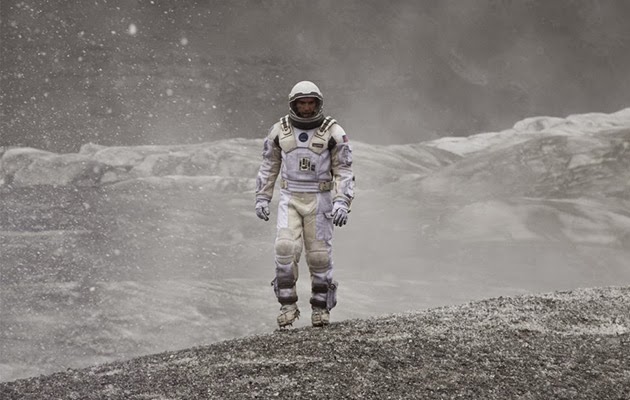
Watch out, McConaughey, you might step into one of those mythical "plot holes."

Ambitious.  A technical masterpiece.  Breathtaking visuals. Blah blah blah.  It seems like Christopher Nolan films have now reached a point that the review, positive or negative, has to state these things.  It always surprises me that people who hate his films will praise Nolan’s work as much as people who love them before they turn their sights on the “plot holes” and other “problems” the film has.  Interstellar is seemingly given this treatment simply because Christopher Nolan directed it.  Nolan, to be fair, kind of brings this on himself.  He has this super-serious quality to him (he wears a suit nearly every day on his sets), he is very secretive about his projects (he reportedly would not let some cast members keep a copy of the script before filming), and he has made enormously popular films (The Dark Knight trilogy, Inception).  He’s all but asking people to nitpick his work and hold his films to a higher standard.  That said, I am one of those people who expect a lot from Nolan’s work, and I found “Interstellar” to be one of the best films of the year, on both a technical and emotional level.

Interstellar is labeled as ambitious for multiple reasons.  First, it’s a film about saving the human race.  Second, it mixes complex science with emotion.  Because of this second aspect, many have labeled the film “too” ambitious, implying that Nolan is unable to resolve any questions put forth by this film.  This is incorrect, however, because there are not that many questions in the first place.  The main query of the film is, “How can the human race survive beyond the planet?”  Interstellar provides the answer to that question.  Detractors simply don’t like the answer given or are not following the film closely enough to pick up on other “answers.”  That is fine, by the way, as the answer of the film is arguably cheesy and sentimental.  It’s just annoying to see a word like “ambitious” used to negatively describe something.  If you don’t like it, fine.  Don’t sugarcoat it to the point that it sounds like you can’t make your mind up.  Because, honestly, what film out there is not “ambitious”?  Are the rest of the movies made by a bunch of slackers who don’t ask and answer questions, or who don’t care if their film is successful or not?    

Before I go on, let me explain my defensive posture for this film.  I watched Interstellar over a week ago and loved it.  It did leave my head spinning a bit, though.  The science of the film along with some stuff about five dimensions and whatnot had me a bit confused.  So I decided to check online for thoughts and theories about the film.  I was surprised to find that the internet movie community (at least the loud part of the community) hated the film or were very dismissive of it.  Many people point to “plot holes” as the main reason for the film being “stupid.”  I watched a video by Screen Junkies on YouTube (not the height of criticism, I know, but certainly a good source for the opinions of the internet movie community) in which the majority of the participants (four out of five) disliked the movie (though they all acknowledged that it was very pretty and ambitious).  In that video, one person talks about a “plot hole” involving a character’s evil actions.  This character turning evil was a “plot hole” to him because (SPOILER) that person had been called “the best of humanity” by another character.  So his rationale is that when it is stated on screen by a character, it must be true.  First off, this logic is incorrect because the character is a person, and people are often wrong when judging another’s character.  Second, why do we take one character’s line as gospel, but dismiss other characters’ lines because we think their logic is “stupid”?  So only certain scientists (the majority of the characters are scientists) are to be trusted?  It’s never established which scientists are to be paid attention to and which are to be ignored. 

Am I being nitpicky with my mini-rant above?  Absolutely, and that’s the point.  It is okay to hate a movie, but to judge it based on the director or how it is being presented to the public is ridiculous.  There is no reason why Interstellar should be picked apart to this degree.  Some claim that since the film is serious and asks big questions, then it should be held under a magnifying glass.  I agree if that scrutiny is for the science that the film almost brags about.  But no one is making any substantial claim to the science being wrong (and people like Stephen Hawking support the film).  Instead, they take issue with the plot.  They question why the characters are going to a risky planet, even though the characters discuss such issues at length on screen!  They complain about the blight in the film and wonder why they don’t just fix the blight when the film has established there is no solution (that information they ignore).  The equivalent of this would be like watching Star Wars and taking issue with Luke leaving with Obi Wan after his aunt and uncle are killed.  “Shouldn’t Luke stay home and deal with the funeral and estate of Owen and Beru?”  “Is he really just going to take off with some crazy hermit on a space adventure?”  Both of these are questions you can certainly ask.  You can even dislike the movie for Luke’s decisions.  But you don’t get to claim it’s a “plot hole” that makes the movie stupid.  Disagreeing with a character’s actions is not a “plot hole,” it’s just something you disagree with. 

The other problem (internet) people have with the movie is the time paradox created by the ending.  (SPOILERS, obviously)  So it turns out that the wormhole they go through was actually created by humans in the future, but how do the humans of the future exist without the wormhole?  There is no explanation for this, which is why the word “paradox” exists in the first place.  Nearly every movie with time travel has this element (see Terminator).  It just comes with the territory of science-fiction and time.  But I would argue that this film at least tries to explain it (Terminator never does; we just accept it) with all the fifth dimension stuff after McConaughey goes through the black hole.  He enters a place where time is a physical object that can altered.  Still, how does he get to this fifth dimension without the wormhole?  I don’t know…science?  Seriously, though, when you start nitpicking films that feature time travel/alteration you’ve entered troll land.  It is science-fiction, after all.  Sure, Nolan wears a suit, and his films are usually super-serious, but he’s still not claiming to be making 100% realistic movies.  He’s trying to make entertaining, interesting films grounded in reality and science.  If you don’t find them entertaining or interesting, fine, but don’t spout off about “plot holes” and paradoxes in this film while you sing the praises of whatever Marvel movie comes out next.  Full disclosure, I love the Marvel movies, but they get a pass because they are meant to be “fun,” and Nolan’s films get picked on because they don’t feature enough comedy.  Speaking of which, when is the internet going to turn on the Marvel universe, anyway?  Now that it’s beloved by seemingly everybody, isn’t it time for the internet to despise it?  That seems to be what’s going on with Nolan these days.  He makes a movie the internet loves (The Dark Knight), and his next few movies receive more hatred than any other films in the genre.

To finish up this messy response to internet hatred of a film I obviously really liked, let me just state that maybe we should be more thankful of Nolan’s films and less nitpicky.  Everyone goes on and on about the lack of originality in Hollywood, yet here’s Nolan directing films based on original scripts.  Sure, he is obviously influenced by other films, but at least Interstellar wasn’t a comic book or old TV show first.  I want him to continue to make “ambitious” sci-fi movies about new things that I don’t already know about.  I love all of the comic book movies coming out, but is anyone truly surprised by anything that happens in them?  Were you shocked when the Avengers put their differences aside and saved the world?  I had no idea what Interstellar was really about until I watched it.  I knew the ending of The Avengers before they even announced the movie: the good guys win.  Once again, I’m okay with the Marvel movies, but why heap so much fun-loving praise on them while we try to destroy one of the only big studio film’s not tied to Disney or some other existing property?  As I’ve been saying, it’s fine by me if you hate Interstellar, just hate it for the right reasons (not that I would agree with any of those reasons…).    

Sunday, June 30, 2013

A Tale of Two Dark Knights

*There will be massive spoilers for all three Christopher Nolan-directed Batman films as well as A Tale of Two Cities by Charles Dickens. 
 
Introduction
 
Before The Dark Knight Rises was released, movie websites were updating the film nearly every hour with all the rumors and news about the film.  The one legitimate piece of information that came from Nolan and company that caught my attention was how the film was influenced by Charles Dickens’s A Tale of Two Cities.  As an English teacher, this definitely intrigued me.  Then the film was released and the geek war over whether it was the greatest or worst movie of all time commenced.  I’m exaggerating, but not all that much (seriously, just check the comments on nearly any post about superhero films in general). 
 
I’m not about to toss my pointless opinion into that battle.  I only bring it up because the Two Cities influence has been lost in the fog ever since.  I’m just as guilty as everyone else (this is being written a year after the release of the film, after all).  I watched the film and all I picked up on was Gordon reading from the novel near the end, there being a revolution in both stories, and the idea that Batman was like Sydney Carton, sacrificing himself for the greater good.  The reason why more aspects of the film didn’t occur to me was because it had been over a decade since I had read the Dickens novel. 
 
Flash forward a few months and I’m teaching the novel to one of my classes.  I read everything that I ask my students to read, even if it means reading it for the second (or more) time.  Before I assigned the book, I told my students that Rises was influenced by it, hoping to create more interest.  It seemed to work on a couple of students, but it really worked on me.  I was noticing many similarities between the entire Nolan trilogy and the novel.
 
While researching any references between the two works online, I was surprised that I couldn’t find a lengthy post comparing the two works.  (There might be one out there, but I didn’t find it in the immediate results.)  Everything I found was on the short side, pointing out the obvious stuff above and discussing how there are similar themes and whatnot.  So I’ve decided to try to point out as many blatant similarities as I can.  By blatant, I mean characters and events, not themes and messages.  Obviously revolution and stuff like that is similar; this is going to be more about which character was Darnay, Carton, Madame Defarge, Dr. Manette, etc. and which events matched up with the storming of the Bastille, the Reign of Terror, etc.  My advance apologies if this isn’t as succinct as it could be, but comparing a blockbuster with classic literature can get pretty messy, and I’m doing this for fun, not for a grade from a professor.  Anyway, here goes.
 
Characters
 
This comparison has to start with Bruce Wayne and Batman, of course.  When you consider that the main character is really two separated characters, it becomes obvious that Two Cities is an influence.  Charles Darnay and Sydney Carton are opposites but look so similar that a jury agrees they could be confused for each other.  Darnay is mysterious but good, while Carton has lived a worthless life and yearns to do something good.  The two characters flip flop when it comes to which one is Batman or Wayne.  When Wayne does the fake partying stuff, he’s Carton.  When he’s Batman, doing the right thing, he’s Darnay.  The fake death of both Batman and Wayne causes a bit of confusion, especially since they both live on, in a way.  Wayne literally goes on to a happy life, and Batman lives on as a concept that anyone can be.  So Batman is Carton in that he died so Wayne/Darnay could live.  But Wayne is also Carton because he fake died so that the concept of Batman could live on.  It’s up for debate, but I think each theory is fair.  The most important part of this theory is that it makes the final scene more interesting.
 

After first watching Rises, I was a little disappointed that Alfred actually got to see Wayne enjoying life after Batman.  Leaving it open-ended would have been fine with me.  And I really liked the idea of actually killing off Bruce Wayne.  When considering Two Cities, however, that scene becomes a bit more necessary if Batman is Carton by the end.  What is the point of his ultimate sacrifice (giving up as Batman), if we don’t get to see if it was worth it?  Part of me still wished the ending had been a bit more bold, but I also like that Wayne’s lifelong struggle with crime and his own demons is essentially over.
 
Since Batman/Wayne is Darnay, that means whomever he loves must be Lucie Manette.  Therefore, Rachel Dawes is Lucie.  The problem here is that Lucie doesn’t die in Two Cities.  This means that Lucie changes characters over time.  This is truly a chink in the Two Cities comparison’s armor because Lucie and Darnay are quite faithful and in love; there’s no switching.  Not only does the character switch, but even actresses were switched out for the role between Begins and Dark Knight.  So Selina Kyle becomes Lucie, but Thalia al Ghul was Lucie for a bit, too.  See what I mean by this being the weak spot?
 

Charles Darnay and Sydney Carton
The only way Lucie can exist as a character in this comparison is if we consider Harvey Dent/Two-Face and Rachel’s relationship as a warning of how Two Cities could have easily ended in a more tragic way.  Dent would be Darnay and Two-Face would be a Carton who never redeemed himself, allowing all three to die.  A cautionary Tale of Two Cities.   
 
Back to comparisons that are a bit easier.  I know Dr. Manette is Lucie’s father and Rachel’s father is not around in the films so that doesn’t work, but there is a still a good connection with Lucius Fox.  Mainly, it’s because Wayne “recalls” Fox to life much like Lorry and company brought Dr. Manette back from his shoe-making.  Fox was a once brilliant man who had been locked away in basically a dungeon until Wayne found him and returned him to prominence, much like how Manette goes from prisoner to revolutionary hero.  Fox doesn’t factor into the narrative nearly as strongly as Manette does, but I think it’s an apt comparison.
 
Sticking with the old folks, Jarvis Lorry is Alfred.  Alfred is a proper British gentleman who serves as the caretaker of the Wayne family.  There’s really not much more to it than that.  Lorry was the driving force of the story of Two Cities (one could say he was the “truck” that carried the characters along…), and Alfred is more on the sidelines here.  But he’s still an essential character. 
 
Lorry’s co-worker/subordinate was Jerry Cruncher, the messenger with a nefarious side job.  Commissioner Gordon is certainly not subordinate to Alfred or anything, but he does work as Cruncher in a way.  He represents the police which would be the blunt force of Cruncher, and he lies to the public about Dent.  He has a skeleton in his closet, and Cruncher digs up skeletons (bodies, really, but let’s go with skeletons for the sake of this article). 
 
That’s enough with the “good” guys.  People love Batman movies for the villains.  Unfortunately, I do not have a good comparison for the Joker.  The Joker has always represented chaos and evil anyway.  There isn’t really a personification of chaos in Two Cities, so if the Joker is anything, he could stand for the rising turmoil in the country of France before the true storm hits. 
 
Moving on from the Joker to some comparisons that are a bit easier to make, Bane and Thalia are a good starting point.  In Two Cities, Defarge appears to be in charge, but we find out that Madame Defarge is the true villain, fueled by her intense need for revenge.  In Rises, Bane appears to be the villain for much of the film, fueling the revolution, or “fire.”  We learn near the end that Thalia is the true villain, and she is also fueled by revenge.  (Although Madame Defarge's brutality is largely transferred to Bane.)  I know that Bane and Thalia are not married like the Defarges (and Madame Defarge definitely does not have sex with Darnay or Carton, as Thalia has sex with Bruce Wayne), but there is still an obvious emotional connection between the two.  The best connection is that both characters use the revolution as their excuse to also get revenge for dead family members wronged by Darnay/Batman. 
 
Ra’s al Ghul is in the same boat as the Joker in that he basically represents revolution in general as a way of wiping the slate clean.  But the Scarecrow can be connected in a more specific way.  It’s more of a cameo than anything, but Scarecrow is the judge who executes or “exiles” the people who have benefited the most from Gotham.  He is the dread tribunal from Two Cities which casts severe judgment for the sins of the past. 
 
Storming the Bastille
Events
 
The dread tribunal brings me to the events that are similar.  The trials and executions are pretty blatantly the Reign of Terror from the French Revolution.  They are described in Two Cities as the “felons” trying the “honest men.”  Perhaps all of the people being tried in Gotham are not completely honest, but the Scarecrow is certainly a felon.  Pretty much everything that happens in Rises represents the French Revolution, but there are specific phrases that tie it into Two Cities. 
 
When a soldier has to sacrifice himself for the cause, Bane assures him that “the fire rises.”  “The Fire Rises” is the title of a chapter from Two Cities.  The “fire” is the revolution, both of Gotham and of France.  It is also referred to as a storm in both stories.  “There’s a storm coming, Mr. Wayne,” warns Selina Kyle.  And Rises is in the title, so there’s that.
 
As for events, the Storming of the Bastille is generally considered the beginning of the French Revolution.  For those who do not know, the Bastille was a prison.  Bane has already started the revolution at the football game (more on that in a second), but it really gets going when he storms the prison and arms the freed prisoners.  That one is fairly obvious.
 
The football game is a little less clear.  I consider this to be an accumulation of the events that cause the people to rise up in Two Cities.  Those events are the Marquis running over a child with his carriage and his subsequent murder at the hands of the vengeful father.  No child is killed by Bane (although we don’t really see what happens to that kid with the “beautiful” voice, do we?), but the mayor/Marquis is killed at the event.  Maybe the mayor isn’t as terrible as the Marquis, but he does represent a bit of power in Gotham.
 
Messages/Themes
  

"The felons were trying the honest men..."
I can’t leave it at just events and characters.  Not to turn this completely into a term paper (and good luck out there if you stumble upon this to use for an essay, because I’ve messed it all up for you by being so informal…), but the themes and messages have to be mentioned a little. 
 
Revenge is definitely a theme that resonates in both stories.  Batman’s very identity is based on getting some kind of vengeance or closure for his parents’ murder.  The actions of Two Cities are all about Madame Defarge getting revenge for what happened in the past.  I think that both stories take a negative viewpoint on revenge.  No one gains peace from it (Madame Defarge dies for it, and Bruce realizes that killing Joe Chill himself wouldn’t have done much). 
 
There is also plenty to say about revolution in general.  Both stories are negative towards it when handled in such a brutal way.  Overthrowing an evil power is not seen as a bad thing, but when you become just as, if not more, brutal than the previous regime, then how is that better?  This is connected with revenge in that when characters allow their emotions to take control, things get worse. 


Finally…
 
The Dark Knight trilogy and A Tale of Two Cities may appear to be unlikely bedfellows, but if the book is fresh in your mind, you’ll notice tons of similarities.  On that note, I’ll finish up by admitting that this is in no way a definitive comparison of the two works.  There are plenty of events and characters I didn’t even mention.  For instance, what about the mob in both stories?  What about the fact that each work has a character named Stryver?  Yeah, I skipped over some stuff.  The point is that comparing these two works is not just possible, it’s obvious.  This is just as deep as I want to go into it because if I have to look any further (like pausing Rises or reading Two Cities for the fifth time) then my enjoyment will turn into work. 
 
As an English teacher and a movie geek, the comparison between The Dark Knight trilogy and A Tale of Two Cities just makes sense and makes both works much more interesting.  I invite any fellow enthusiasts out there to find their own comparisons and whatnot, mainly because I want to read more stuff about this, especially if it didn’t occur to me (or cause me to do more work).  Sometimes it’s possible to look beyond the love/hate relationship people develop with the over-hyped movies and apply some thought to it all.  And if you truly love movies, then that’s something you’ll want to be a part of.